



Plagiarism or theft?
I have a friend and watercolour teacher/artist/writer Kees van Aalst.
Maybe you have one of his books?
I found a article I may use
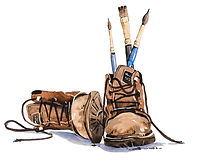
Said Hamlet to Ophelia: “I’ll draw a sketch of thee, what kind of pencil shall I use? 2B or not 2B?”
Would a charge of plagiarism by Shakespeare be successful in this case? I doubt it.
When you give a creative twist to an existing thing, such as here, the courts are often inclined to be lenient.
But literal copying is a different story, in fine art as much as in literature. Don’t do it, that’s all I need to say.
In this ultrashort exploratory article, I’m not going to talk about successful thieves from art history such as Warhol or Lichtenstein, nor about the forgers’ guild that is only interested in monetary gain.
Instead, I want to find out how you can draw inspiration from other people’s work without literally copying it.

Existing images are often utilised in the art world. No one creates something from nothing. There are always influences, but a creative artist knows how to alter that influence in such a way that it becomes part of his or her own work virtually unnoticeably.
Picasso had a strong opinion about stealing other people’s products. “Good artists copy, great artists steal” was his thesis. Copying is plagiarism, it’s not very creative. By stealing, you appropriate the work and make it your own. Originality then becomes skill-fully disguised imitation. After all, the point isn’t where you get your ideas, but what you do with them.
So don’t be ashamed to use other people’s work as a source of inspiration. Collect images of work that speaks to you, and use them as a catalyst and an incentive to improve your own work. You’ll be more driven, more proficient in this way, resulting in work that has its own style and character. Finally, a tip: ● Set the bar high. For inspiration, study the works of great artists you admire, not the dabblings of well-meaning amateurs. Those don’t teach you anything.
Kees van Aalst www.keesvanaalst.nl
Edo, I would have to disagree with you here. There is a long tradition of the master/apprentice approach to learning a skill. This is where the master carries out a task and the apprentice copies the way the master has done it. I have found over the past few years that I use this approach when trying to learn a new technique, say for example how to paint some skies. And Olly actually encourages us to follow his example in the latest video on skies. I also subscribe to some other artists lessons who use the painting along approach and I have found these have helped me greatly to learn and develop. But then once the skill is mastered it is then time to apply to our own creative compositions.