


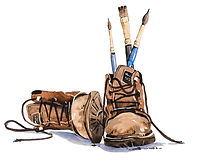

Making your own work is more satisfying.
A Beginner's Guide to Watercolor Painting
Introduction
Watercolor painting is a rewarding and expressive medium, but to truly master it, you must focus on more than just replicating others’ work. This guide will help you build a strong foundation in technique, composition, and color use, enabling you to create original and personal artwork.
1. Understanding the Fundamentals
To become a skilled watercolorist, you need to delve into the core techniques of painting itself. These include:
Washes – Learning to control the flow of water and pigment for even and graded washes.
Wet-on-Wet vs. Wet-on-Dry – Understanding how paint behaves on damp or dry paper.
Glazing – Layering transparent colors to build depth and richness.
Dry Brush – Creating texture and detail with minimal water.
Mastering these techniques will give you control over your painting and allow you to develop your own unique style.
2. Composition and Layout
A strong painting begins with a well-thought-out composition. Consider:
Balance and Harmony – Ensure that elements are arranged in a pleasing manner.
Focal Point – Guide the viewer’s eye to the most important part of your painting.
Contrast and Light – Use values effectively to create depth and interest.
3. The Power of a Limited Palette
Using too many colors can overwhelm your painting. Instead, work with a limited palette to develop a sense of color harmony and unity. Choose a few primary colors and learn to mix them effectively. This approach simplifies decision-making and strengthens your understanding of color relationships.
4. Learning Through Application, Not Imitation
While YouTube tutorials can be valuable for learning techniques, avoid the temptation to simply copy finished paintings. Copying may teach you how another artist paints, but it will not develop your own skills or creative voice. Instead:
Practice individual techniques and apply them to your own compositions.
Experiment with different subjects and styles.
Learn from mistakes and adapt your approach accordingly.
5. The Importance of Personal Exploration
True artistic growth comes from pushing your own boundaries. Make mistakes, analyze what works and what doesn’t, and refine your techniques through experience. By focusing on technique and personal expression rather than imitation, you will progress more quickly and develop a style that is uniquely yours.
Conclusion
Watercolor painting is a journey of learning and self-discovery. By mastering techniques, understanding composition, and working with a limited palette, you will build a strong foundation. Most importantly, apply what you learn to your own work—this is the key to true artistic growth. Happy painting! Remember, every time you practise, it is a investment in your own skills Below, three times the same view, in different approaches.


Thank you for this post, Edo, and the lovely paintings that accompany it.